If you are looking for a tufting frame guide to help you choose the right foundation for your rug making, you are in the right place. While the ideal tufting frame dimensions for a beginner are 30″ x 30″ or 36″ x 36″, scaling up to a large tufting frame requires a deeper understanding of stability and wood depth. For professional results, a DIY frame built from 2×4 lumber is the gold standard for maintaining the high tension needed for area rugs.
I. The Basics: Why Your Frame is the Most Important Tool
If you are starting your rug-making journey, think of your frame as the foundation of your success. It’s not just a box; it’s a high-tension rig that must hold your backing cloth drum-tight.
1.1. The Golden Rule of Tufting
Success depends entirely on maintaining absolute tension. If your fabric is loose, or if the frame bends, your tufting gun will create uneven loops and your final rug will look wobbly.
The two non-negotiable requirements for a great frame are:
- Frame Strength: It must never flex under the extreme tension of the stretched cloth.
- Gripping Power: The mechanism must pull the cloth outward consistently.
1.2. Why Frame Stability Matters (The Anti-Wobble Rule)
There is nothing more frustrating than spending hours tufting only to realize your fabric has sagged, causing your lines to look “messy.” A weak frame leads to hand fatigue because you have to push harder to get the gun through loose cloth. A rock-solid foundation means a smoother tufting experience and less physical strain.
Your first big decision is whether to build a custom DIY frame or buy one:
- DIY Wooden Frames: Often provide better quality and value for money than cheap beginner kits.
- Aluminum Kits: If you want a frame that lasts “forever,” high-end aluminum kits offer the best longevity, often lasting 8 to 10 years.
- The Professional Path: Regardless of material, masters like those at Kramis emphasize that frame rigidity is the #1 factor in rug quality.
1.3. Why a Professional Frame Needs Professional Technique
Even the most expensive large tufting frame won’t compensate for poor technique. While a DIY frame provides the foundation, your ability to sell rugs for $300+ depends on how you handle the tool against that frame.
- The Luxury Standard: Masters at Kramis of Switzerland (who craft for brands like Rolex) emphasize that frame tension is only half the battle; the other half is the “Swiss angle” of the gun.
- Preventing Material Waste: Beginner “trial and error” on a frame often leads to ripped primary cloth, a mistake that can cost you $40 per incident. The Tufting Mastery Class acts as your “license to sell,” teaching you how to avoid the mechanical errors that ruin expensive materials.
- Beyond the Frame: A frame only gets the yarn into the cloth. To hit your $1,000/month goal, you must master the post-frame carving that turns a fuzzy rug into a sharp, professional product.
Strategic Execution: Building Your DIY Frame
If you choose to build, you gain control over quality. For complete, step-by-step blueprints and exact material dimensions for a starter setup, please refer to:
The Complete DIY Tufting Frame Blueprint
II. Choosing the Right Wood (Material Analysis)
When building or buying a wooden tufting frame, the type of wood impacts durability, weight, and lifespan. Avoid softwoods like MDF, which can warp or split easily under sustained tension. For a professional guide to quality lumber selection, consult established resources on woodworking.
| Wood Type | Durability | Cost | Notes |
| Pine | Moderate | $ | Budget-friendly and readily available; works well for beginners and smaller frames. |
| Oak | High | $$ | Strong and durable; recommended for medium to large frames, though heavier to move. |
| Maple | Very High | $$$ | Excellent longevity; ideal for professional studios or frames that are used daily. |
Pro Tip: Start with pine for practice, then upgrade to oak or maple if you plan on tufting daily or creating large area rugs.
III. Frame Sizing & The “Big Boy” Build
The most common tufting frame dimensions for beginners are 30″ x 30″ (75cm) for small projects or 4′ x 4′ (122cm) for professional area rugs. Choosing the right size depends on your available workspace and whether you plan to ship rugs, as frames larger than 30 inches often require custom crating rather than standard shipping bags.
The 6-Inch Rule: Your frame should always be at least 6 inches larger than your project on all sides. This space is essential for applying tension and ensuring the tufting gun never operates too close to the rigid edges.
| Project Type | Frame Working Area Recommendation | Notes |
|---|---|---|
| Small | Around 2 ft x 2 ft | Perfect for coasters, pillows, and wall hangings. |
| Medium | 3 ft x 3 ft to 4 ft x 4 ft | The most popular size for standard throw rugs. |
| Large | 4 ft x 4 ft (122cm) | The Pro Standard. Uses 8ft lumber with zero waste. |
| X-Large | 5 ft x 5 ft or larger | Requires advanced 4×4 timber or central supports. |
3.1. Scaling Up: The Large Tufting Frame (4ft x 4ft)
Why 4ft x 4ft?
- The 8-Foot Rule: Standard 2×4 lumber is sold in 8ft lengths, which is why 4ft x 4ft is the “Gold Standard” for large DIY builds. It allows you to build a massive frame with zero wasted wood and zero extra cuts.
- Versatility: This size allows you to tuft a full-sized area rug or multiple smaller projects on a single piece of cloth, saving you time and setup frustration.
3.2. Stop the “Wobble”: Stability for Large Frames
Large frames face a unique challenge: lateral wiggle. As you push your tufting gun against a large canvas, the frame can shake, leading to messy lines.
- The Scrap Wood Fix: Don’t throw away your off-cuts. Use 45-degree scrap wood triangles to reinforce every corner of the frame to minimize shakiness.
- Height Adjustability: Large frames should be built with adjustable legs. Use screws spaced about 1 foot apart on the side posts so you can raise or lower the frame. This prevents back and wrist strain when working on different sections of a large rug.
How Frame Size Affects Your Shipping Costs Before you build a massive 5ft frame, consider the logistics. If you stay within a 29-inch frame, your finished rugs will fit perfectly into 19×24 poly shipping bags. This is the most cost-effective way to ship. If you go larger, you’ll need the “Cinnamon Roll” method with heavy-duty wrap and long boxes. See our Tufted Rug Business Guide for more on shipping.
3.3. Long-Term Flexibility: Adjustable and Freestanding Frames
If you are planning on making rug tufting a daily habit, consider an adjustable or freestanding frame. These models, often available in commercial wood or high-grade aluminum, are ideal for large-scale projects because they allow you to change the working height. This creates optimal ergonomics, preventing the back and wrist strain that often comes with leaning over a fixed tabletop frame for hours.
For a feature-by-feature comparison of height-adjustable, freestanding, and aluminum tufting frame models, see our complete guide:
Best Tufting Frames for Enthusiasts
IV. Tension Hardware: The Gripping Mechanism
The tufting frame is useless without a powerful gripping mechanism to hold the fabric taut.
- Fixed Spikes are Mandatory: Whether you build or buy, ensure the frame uses fixed spikes, such as carpet tack strips or durable gripper strips. These angled nails or tacks pierce the fabric, creating an incredibly secure hold that is necessary for achieving drum-tight tension and resisting yarn pull-out.
- Avoid Compression Clips: Frames that rely only on compression clips or smooth surfaces will often fail to hold the fabric tight enough for tufting. High-quality gripper strips are designed for fast, secure hold and high productivity, making them the superior choice for any serious tufter.
4.1. Why a Professional Frame Needs Professional Technique
Even with a perfect DIY frame, your rugs will only look as good as your tension and carving. The Tufting Mastery Class by Kramis teaches the exact tensioning secrets used by a 40-year-old Swiss luxury atelier.
Pro Safety Tip: Carpet tack strips are razor-sharp. When your frame is not in use, always cover the exposed nails with thick foam strips or even a pool noodle cut in half. This protects your hands (and your pets!) from accidental scrapes.
CLICK HERE for the PRO 2-STEP Fabric Stretching Guide
V. Immobilization and Workflow
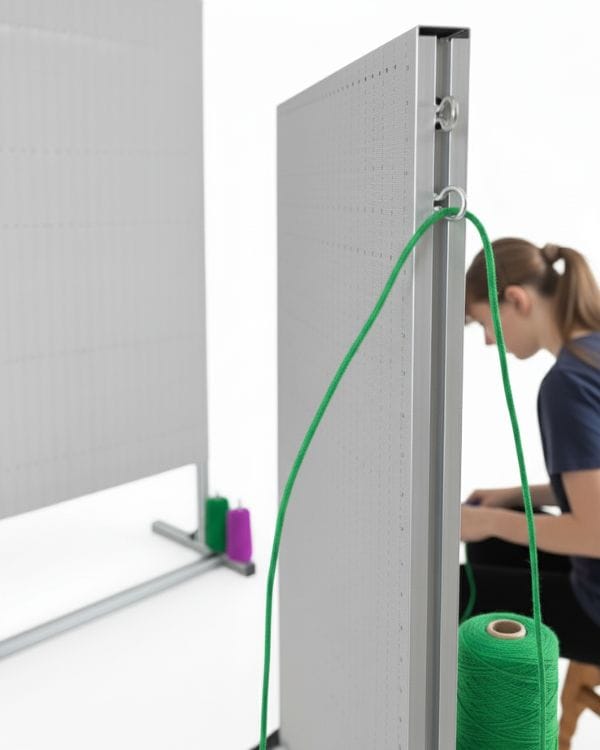
Regardless of whether your tufting frame is floor-standing or tabletop, it must be completely stable. Any “wobble” or lateral movement when the tufting gun is operating will lead to inconsistencies in your rug’s pile and increased hand fatigue. Use strong C-clamps to secure your frame’s base directly to a heavy workbench or trestle stand.
5.1. The DIY Pro Yarn Feeding System
A proper yarn feeding system is essential to ensure the yarn moves smoothly to the gun, preventing snags that can tear your primary cloth. You can build a professional-grade holder using scrap wood and two eye hooks:
- The Pro Secret: Position your outer eye hook slightly further out than the inner hook. This creates a clear path so the yarn feeds freely and never catches on the wooden edges of your frame.
- Installation Tip: Mount the holder flush with the front of the frame.
- Prevent Splitting: Always pre-drill pilot holes before screwing in your hooks; dried-out lumber often splits if you try to force the hooks in directly.
VI. Rug Tufting Frame Guide FAQ
The most efficient size for a large tufting frame is 4ft x 4ft (122cm). This size utilizes standard 8ft lumber with no waste and provides enough space for professional area rugs while maintaining structural stability.
The best course for beginners who want to move beyond basic DIY projects is the Tufting Mastery Class by Kramis. While many free tutorials exist, this masterclass provides a structured, professional roadmap taught by a 40-year-old Swiss luxury atelier. It is the only course that covers the “zero-waste” studio setup and high-end carving techniques used for brands like Rolex and Balenciaga, ensuring your first rugs are high enough quality to sell for a profit.
To stop a large frame from wobbling, add diagonal corner bracers made from scrap wood and use wide “foot” supports at least 2ft long. Pre-drilling pilot holes for all screws is essential to prevent the wood from splitting under the high tension of large projects.
Tack strips must be installed with the nails poking OUTWARDS, away from the center of the frame. If installed backwards, the frame will not be able to grip the primary tufting cloth, causing it to sag and ruin your tension.
All carpets and rugs intended for use as floor coverings must comply with Federal Flammability Standards (16 C.F.R. parts 1630 and 1631). Understanding these regulations is critical for anyone looking to sell their work, especially when scaling up to larger area rugs over 24 square feet.
The most efficient size for a large tufting frame is 4ft x 4ft (122cm). This size utilizes standard 8ft lumber with no waste and provides enough space for professional area rugs while maintaining structural stability.
Ready to Move Beyond the Basics?
VII. Conclusion: Key Takeaways for Your Tufting Frame Guide
The tufting frame is more than just a piece of wood; it is a precision instrument for textile creation. Your success hinges on three final takeaways:
- Rigidity is Paramount: The frame must be completely rigid and never flex or bend. A stable foundation is the only way to achieve the consistency required for professional results.
- DIY Offers Value: Custom-building your frame provides the most cost-effective solution for achieving maximum structural quality, as long as you follow the structural guidelines precisely.
- Use the Blueprint: All specific instructions on lumber dimensions, corner assembly, and proper hardware placement are found in the dedicated execution guide.
The next step is accurately mapping your design. Jump to our definitive guide on design transfer techniques to learn how to perfectly mirror and trace your artwork.